


 Last week saw the European Parliament dedicate a series of high-level events on science, and more precisely the need to ensure science and policy are more actively and efficiently intertwined. Through talks, but also interactive group sessions, participants had the opportunity of seeing the importance science communication plays in shaping political discourses. The rising distrust in scientific advice and of ‘experts’ was also a major focus, with discussions concentrated on how to counter this changing landscape. Member of the European Parliament Paul Rübig also praised the MEP-scientist pairing scheme as a successful way of bringing science and policy closer together. EuChemS can testify to this, having in the past taken part. Nevertheless, with only a handful of MEPs signing up to the scheme, its impact is limited.
When international collaboration creates Chemistry
With no clear end in sight in Brexit negotiations, the impact on scientific collaboration, funding, and mobility between the UK and the rest of the EU remains largely unclear. Moreover, trialogue negotiations between the European Council, European Parliament, and the European Commission are moving forward, meaning that the future research framework programme, Horizon Europe, is aimed at being finalised in the coming months.
In August 2018, EuChemS published its Position Paper on Horizon Europe, stating that the programme should enable countries that had previously participated in EU research framework programmes (such as Horizon2020) be allowed to do so in the future. More recently, EuChemS Member Society the Royal Society of Chemistry (RSC), published a short report which looks at the benefits of international collaboration. The report draws on the key findings of 10 in-depth case studies with chemical researchers and entrepreneurs in the UK and in Europe. The conclusion? International collaboration creates better and more impactful science.
Read the full story here.
ECHA submits proposal for ban on microplastics
ECHA, the European Chemicals Agency, submitted on 30 January an official proposal to restrict microplastic particles that are intentionally added to mixtures used by consumers or professionals. ECHA believes that if the restriction is adopted, the amount of microplastics released in the environment in the EU would drop by some 400 thousand tonnes over 20 years.
Intentionally created microplastics represent between 15-31% of all microplastics found in the oceans. The other sources of microplastics, also known as secondary microplastics originate from the degradation of larger plastic objects (bottles, bags…).
In September 2018, the European Parliament approved a plastics strategy which aims to increase the recycling rate of plastic waste in the EU, as well as an EU ban on certain single-use plastic products. They furthermore called on the European Commission to introduce an EU-wide ban on intentionally added microplastics in products such as cosmetics and detergents.
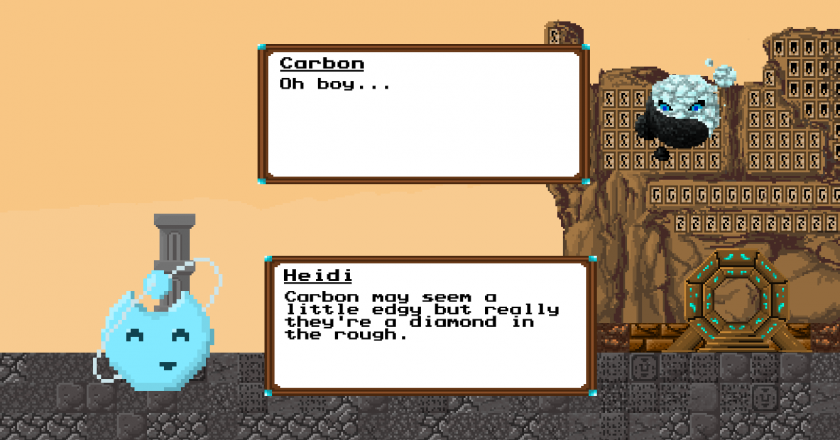
‘Elemental Escapades!’: the new EuChemS video game
Transported to an alien world where everything looks unfamiliar, Jan is asked to help find missing elements and use their properties to create compounds in order to find a way out and escape. Join the adventure where you can learn simple chemistry through EuChemS’ new video game ‘Elemental Escapades!’. Developed to provide an entertaining means of learning chemistry, the video game is a project created in light of the International Year of the Periodic Table. Download and play the game here!
The #IYPT2019, the Periodic Table and EuChemS

On 22 January, the EuChemS Periodic Table was unveiled by EuChemS President Pilar Goya and MEP Catherine Stihler alongside the oldest known wallchart of the Periodic Table at an event in the European Parliament.
With speakers from the scientific community and from the European Parliament and the European Commission, participants were delivered an outstanding talk, encompassing issues such as element scarcity, EU-led actions in the area, elements at the deep-sea level, the meaning and importance of the International Year of the Periodic Table (IYPT2019), as well as the exhilarating discovery of the Periodic Table wallchart in Saint Andrews.
It was all the more encouraging to see a wide variety of participants attend the event, from representatives from chemical societies, EU institutions, advocacy groups, and a class of some 25 pupils from the European School of Brussels.
We were particularly pleased to see the event and the Periodic Table picked up in news outlets across the world, from the UK to Australia. Listen to David Cole-Hamilton on BBC world, and take a look at this informative article in The Guardian.
Presentations for the event are available online here.

Celebrations for the IYPT2019 truly kicked off on 29 January at the UNESCO offices in Paris, where some 700 participants from across the world came together for a series of talks from leading scientists, along with an entertaining and informative exhibition area. A delegation of EuChemS members were present, along with EuChemS President Pilar Goya, and the secretariat. On display was the Periodic Table depicting element scarcity – which in turn was put in the spotlight by famous YouTuber Sir Martyn Poliakoff during his presentation on the Periodic Tables to be found in his office.
Speakers also included UNESCO Director-General Audrey Azoulay, Chemistry Nobel Laureate Ben Feringa, and Yuri Oganessian, pioneer in the discovery of super-heavy elements.
The event, mixing entertaining and accessible talks with crucial and complex presentations on scientific developments, together with a chemistry bar to unwind, was a great taster of what the year ahead has planned for us.
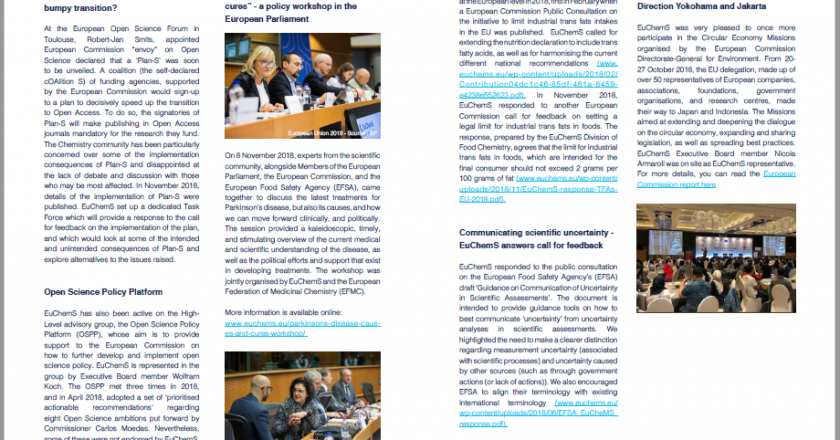
Year Book 2018 published
EuChemS has published the 2018 Year Book, offering a summary of the many activities and initiatives of 2018. The annual overview includes an editorial by EuChemS President Pilar Goya, as well as insights into EuChemS’ policy actions, recognised events, awards, and Professional Networks. Take a look for a complete insight into the many activities EuChemS has taken part in!
The Year Book is now available for download online.
EuChemS issues statement on the implementation guidelines of Plan S and attends latest OSPP meeting
EuChemS has issued a Position Paper on the implementation guidelines of Plan S.
On 4 September 2018, ‘cOAlition S’, a coalition of national research funders, supported by the European Commission, launched ‘Plan S’, an initiative to accelerate the transition to open access in scientific publishing. Currently, several national funding bodies in Europe have committed to Plan S, others have not. The plan consists of 10 principles for the transition to Open Access and more specific implementation guidelines were published by cOAlitionS on 27 November 2018.
“EuChemS supports the transition to Open Access (OA) in scientific publishing. Access to research and dissemination of knowledge is a fundamental purpose of our community’s values and aims. As a representative for research chemists and chemical societies across Europe, we welcome the conversation and the debate that this has engendered and look forward to working together with all stakeholders on finding sustainable solutions that secure the interests of researchers, societies, funders, librarians and publishers involved in the important task of disseminating scientific research.
Although the implementation guidelines provide some clarifications, we believe the consequences of Plan S remain unclear and could undermine the visibility and vitality of European research on a global stage if not properly implemented.”
On 29 January, EuChemS attended the High-Level Open Science Policy Platform (OSPP) meeting in the European Parliament, with discussions touching upon indicators for research engagement, and the role of rewards and incentives. The OSPP is a high-level group tasked with providing feedback and guidance to the European Commission on the implementation of Open Science in Europe. EuChemS is represented in the group by Executive Board Member Wolfram Koch.
Raw Materials and Environment 2019
Raw Materials and Environment 2019
19 – 20 February 2019
Berlin, Germany
Website: https://www.umweltbundesamt.de/en/raw-materials-environment-2019-start
Science meets Parliaments: What role for science in the 21st century policy-making
Science meets Parliaments: What role for science in the 21st century policy-making
6 – 7 February 2019
Brussels, Belgium
Website: https://ec.europa.eu/jrc/en/event/conference/science-meets-parliaments-2019
International R&D: Horizon Europe and the world
International R&D: Horizon Europe and the world
5 February 2019
Brussels, Belgium
Website: https://sciencebusiness.net/events/international-rd-horizon-europe-and-world
Food Safety in the EU: Maintaining High Standards and Ensuring Transparency of Information
Food Safety in the EU: Maintaining High Standards and Ensuring Transparency of Information
29 January 2019
Brussels, Belgium
Website: http://www.publicpolicyexchange.co.uk/events/JA29-PPE1
International Summer School on Natural Products (ISSNP)
International Summer School on Natural Products (ISSNP)
1 – 5 July 2019
Naples, Italy
Website: http://bit.ly/2RoAwji
1st International Meeting on Deep Eutectic Systems
1st International Meeting on Deep Eutectic Systems
24 – 27 June 2019
Lisbon, Portugal
Website: https://bit.ly/2ry3xd1
17th International Conference on Chemistry and the Environment – ICCE2019
17th International Conference on Chemistry and the Environment – ICCE2019
16 – 20 June 2019
Thessaloniki, Greece
Website: https://bit.ly/2QPstIg
14th International Symposium on Macrocyclic and Supramolecular Chemistry (ISMSC2019)
14th International Symposium on Macrocyclic and Supramolecular Chemistry (ISMSC2019)
Lecce, Italy
2 – 6 June 2019
Website: http://bit.ly/2yaNa9V
1st GHI World Congress on Food Safety and Security (GHI2019)
1st GHI World Congress on Food Safety and Security (GHI2019)
Leiden, Netherlands
24 – 28 March 2019
Website: http://bit.ly/2PrzhL8
EuChemS workshop: Chemical sciences – the gap between skills and jobs
Brussels, Belgium
7 March 2019
Setting their Table: Women and the Periodic Table of Elements
Setting their Table: Women and the Periodic Table of Elements
11 – 12 February 2019
Murcia, Spain
Website: https://bit.ly/2RHEkIf
Chemistry Rediscovered – just 2 weeks to go!
The EYCN has launched the second edition of its video competition Chemistry Rediscovered, this time putting the International Year of the Periodic Table at its heart. All chemists between the ages of 12 and 35 years are invited to send in videos on the theme “In Your Element”.
More information available online: https://www.euchems.eu/divisions/european-young-chemists-network/chemistry-rediscovered/
Deadline: 31 January 2019
Joint call for proposals on microplastics in the marine environment
Twelve JPI Oceans member countries together with Brazil launched a call for transnational research projects worth some €2.9 million to study the sources, distribution and impact of microplastics in the marine environment.
Deadline: 28 February 2019
Website: http://www.jpi-oceans.eu/calls/proposals/microplastics-marine-environment
Call for proposal: solar-driven chemistry 2019/2020 – deadline approaching
The EuChemS-initiated multinational call for projects on “solar-driven chemistry” was signed by 5 national funding organisations and was published on 14 December. The challenge, namely, the conversion of solar energy into chemical compounds through technical processes, and by means of artificial compounds and using available raw materials (carbon dioxide, water) remains a visionary goal. Many fundamental scientific questions will need to be answered before it can be implemented in a meaningful way on a technical scale, but the social impact of such advances is tremendous. More information on the call available online here.
Deadline: Wednesday 13 February 2019.
EFSA public consultation on the active substance paraffin oil.
EFSA has a launched a public consultation on the active substance paraffin oil.
Drop us a line if you would like to contribute to an EuChemS response! Deadline to send us feedback: 5 February 2019.
European Commission draft regulation ‘Reference points for action for non-allowed pharmacologically active substances’
Call for feedback on the European Commission draft regulation ‘Reference points for action for non-allowed pharmacologically active substances’
Drop us a line if you would like to contribute to an EuChemS response! Deadline to send us feedback: 3 February 2019.
Multi-billion-euro investment in the port of Antwerp by British chemical company Ineos
The British chemical giant Ineos is to invest some €2.7 billion in two new petrochemical plants in the port of Antwerp. The investment will be the biggest ever made by a European chemical company in the last twenty years, and the biggest ever by Ineos itself. The construction of the two factories, which will take some four to five years is set to create some 500 new jobs. The Financial Times reports that Ineos’ plans include the building of a 1m tonne ethan cracker that will turn ethane into ethylene, a major building block for plastics. Read the full story here.
Glyphosate risk assessment report copy-pasted from industry contributions
A report presented in the European Parliament on 15 January, mandated by Members of the European Parliament, shows that some 50% of the risk assessment content used by the EU to formulate its opinion on glyphosate, copies, at times with the exact same wording, contributions from Monsanto and other companies. The new report comes ahead of an important vote on the conclusions of the European Parliament’s Pesticides Committee at the Plenary.
In May 2017, EuChemS organised a key workshop on Glyphosate in the European Parliament, chaired by MEP Pavel Poc. The workshop which aimed at presenting the opinions of scientists ultimately demonstrated a need to pursue further studies and the need to establish a standard method for reliable measurements of glyphosate in different types of samples.
You must be logged in to post a comment.