


 On 7 March 2019, EuChemS will be holding a workshop in the European Parliament, focusing on Horizon Europe, education, employment, and more specifically, the existing gap between skills and jobs. The workshop will be chaired by Member of the European Parliament (MEP) Van Nistelrooij. More details on the programme and registration will soon be communicated. Watch this space!
Horizon Europe & Brexit
A number of EU Politicians have butted in on what a future relationship with the UK should look like post-Brexit. The view is that the UK and its strong research institutions should continue to fully collaborate in EU research framework programmes but that their participation should be a full one, stating that ‘they should be part of all or none’ [of Horizon Europe] reports Science Business. Both the UK and other EU Member States have stressed that continued cooperation in research and innovation is a priority once the UK leaves the EU, a position that EuChemS has also underlined in its statements on Horizon Europe.
The full extent of collaboration on Horizon Europe will not be clear until the UK’s departure and subsequent negotiations on both the final research framework programme and the new relationship between the EU and the UK.
Romanian Presidency of the Council of the EU – priorities
From January until June 2019, Romania will hold the Presidency of the Council of the EU. During this 6-month period, the presidency chairs meetings at every level in the Council, aiming to set goals, prepare a common agenda determining the major topics and issues to be addressed, as well as helping Member States come to final agreements and compromises. Romania’s presidency intersects with the finalisation of a number of important policy issues, significant political events (Brexit), as well as the upcoming European Parliament election in May. Indeed, over the next 5 months, the future multiannual financial framework (the EU’s long-term budget for 2021-2027) which includes Horizon Europe, will be a significant focus of debate. Romania has set out a number of priorities: promoting research and innovation, digitalisation, internal security, EU defence capabilities, and a push for greater common values in terms of democracy, equal opportunities, and human dignity. Romanian ministers have predicted that the finalisation of the EU budget agreement will be a difficult challenge but have also vowed to represent eastern, western, northern and southern Europe in order to achieve a final agreement before the May elections. Science Business analyses the situation.
Clean Energy Package moves forward
On 18 December 2018, negotiators from the Council, the European Parliament and the European Commission provisionally agreed on new rules for making the EU’s electricity market work better – a move which marks a significant step forwards to finalising the Clean Energy for All Europeans package and subsequently, the Energy Union. The agreement also marks a step forwards in the fight against climate change and an accelerated move to the clean energy transition.
Meanwhile, the Committee for Industry Research and Energy of the European Parliament will vote on 23 January on the agreement on the Electricity Market Design Directive and Regulation, which was reached on 19 December 2018. The agreed texts aim to increase cross-border flows of electricity from renewable sources, end state subsidies to polluting coal power plants, as well as introduce technologies to help customers better control their energy usage.
IYPT2019 and element scarcity
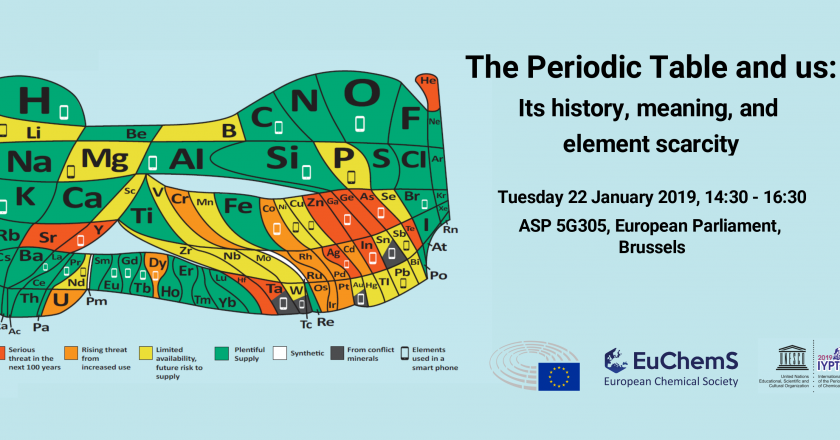
Celebrating the IYPT2019 also means looking at what the chemical elements mean to us today. EuChemS recently developed and unveiled a unique Periodic Table which depicts the abundance (on a logarithmic scale) of chemical elements. The table shows the abundance of elements under serious threat in the next 100 years, those under increasing threat due to their increasing use, those with limited availability, as well as those coming from conflict zones. Finally, a smartphone symbol was added to the Periodic Table to show which chemical elements are used to make our phones – many of which are come from areas of conflict or under serious threat.
On 22 January, EuChemS will present and discuss this new Periodic Table at an event in the European Parliament, titled ‘The Periodic Table and us: its history, meaning and element scarcity’, chaired by Member of the European Parliament (MEP) Catherine Stihler. The event will feature opening talks from MEP Catherine Stihler and EuChemS President Pilar Goya. David Cole-Hamilton, EuChemS Vice-President will unveil the Periodic Table and discuss element scarcity and our role in protecting endangered elements. Natalia Tarasova, IUPAC Past President will in turn discuss the IYPT2019; Brigitte Van Tiggelen, science historian and Chair of the EuChemS Working Party on the History of Chemistry, will look at the history surrounding the Periodic Table as we now know it; M. Pilar Gil, University of St Andrews, will present oldest known Periodic Table wallchart. The event will also include presentations from Peter Handley, Head of the Resource Efficiency and Raw Materials Unit in the European Commission’s Directorate-General for Growth who will discuss critical raw materials in the circular economy and strategic value chains and Horizon 2020/Europe; as well as Andreea Strachinescu, Head of Unit of the European Commission Directorate-General for Maritime Affairs, who will discuss ocean resources. MEP Clare Moody will make the closing remarks.
More information on the event available here: https://www.euchems.eu/periodic-table-and-us/
More information on elements in danger is available here
International Year of the Periodic Table – IYPT2019
Proclaimed the International Year of the Periodic Table by the United Nations General Assembly and UNESCO, 2019 will be the 150th anniversary of Dmitri Mendeleev’s discovery of the Periodic Table (interestingly, several scientists in Europe developed Periodic Systems and systemisation attempts around the same time. You may recognise names such as Antoine Lavoisier, Alexandre-Emile Beguyer de Chancourtois, John Newlands and the familiar name of Julius Lothar Meyer).
The IYPT2019 will be launched at an Opening Ceremony in Paris on 29 January 2019. Some of the speakers include Ben Feringa, Youri Oganessian and Sir Martyn Poliakoff. Pilar Goya, EuChemS President will also take to the stage and present the EuChemS Periodic Table as well as unveil the new video game developed by EuChemS – which will be available to try out for the very first time at the event.
Not registered yet? Click here!
The IYPT2019 is an initiative set off by the Mendeleev Chemical Society, and with the support of IUPAC, UNESCO and 5 founding partners including EuChemS.
IUPAC has also created a webpage which lists events and activities worldwide linked to the IYPT2019: https://www.iypt2019.org/events
Organising an event in Europe? You can also apply for the EuChemS recognition scheme: https://www.euchems.eu/iypt2019-event-submission-form/
Launch of the 2019 International Year of the Periodic Table of Chemical Elements (IYPT2019)
Launch of the 2019 International Year of the Periodic Table of Chemical Elements (IYPT2019)
29 January 2018
Paris, France
Website: https://bit.ly/2DJkkSC
1st International Meeting on Deep Eutectic Systems
1st International Meeting on Deep Eutectic Systems
24 – 27 June 2019
Lisbon, Portugal
Website: https://bit.ly/2ry3xd1
17th International Conference on Chemistry and the Environment – ICCE2019
17th International Conference on Chemistry and the Environment – ICCE2019
16 – 20 June 2019
Thessaloniki, Greece
Website: https://bit.ly/2QPstIg
14th International Symposium on Macrocyclic and Supramolecular Chemistry (ISMSC2019)
14th International Symposium on Macrocyclic and Supramolecular Chemistry (ISMSC2019)
Lecce, Italy
2 – 6 June 2019
Website: http://bit.ly/2yaNa9V
1st GHI World Congress on Food Safety and Security (GHI2019)
1st GHI World Congress on Food Safety and Security (GHI2019)
Leiden, Netherlands
24 – 28 March 2019
Website: http://bit.ly/2PrzhL8
Setting their Table: Women and the Periodic Table of Elements
Setting their Table: Women and the Periodic Table of Elements
11 – 12 February 2019
Murcia, Spain
Website: https://bit.ly/2RHEkIf
The Periodic Table and us: its history, meaning, and element scarcity
The Periodic Table and us: its history, meaning, and element scarcity
22 January 2019
Brussels, Belgium
Website: https://bit.ly/2SJQqkF
EYCN’s Chemistry Rediscovered
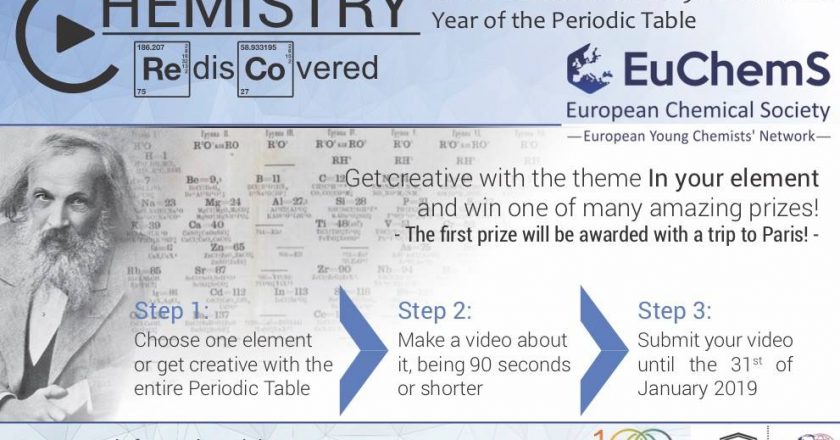
The EYCN has launched the second edition of its video competition Chemistry Rediscovered, this time putting the International Year of the Periodic Table at its heart. All chemists between the ages of 12 and 35 years are invited to send in videos on the theme “In Your Element”.
More information available online: https://www.euchems.eu/divisions/european-young-chemists-network/chemistry-rediscovered/
Deadline: 31 January 2019
Award for Service & Lecture Award – just 15 days left
Each year, the major achievements of one junior scientist working in chemistry in a country with a EuChemS Member Organisation will be rewarded. The call for nominations for the Lecture Award is open and submissions must be made online here. The winner will receive a statuette and the opportunity to give a lecture at the next European Chemistry Congress (ECC) or at a conference of an EuChemS Professional Network (PN).
Deadline: 31 December 2018
All EuChemS Member Organisations, Divisions/Working Parties and individuals are invited to submit nominations for the 2019 EuChemS Award for Service. This award acknowledges outstanding commitment with regard to fostering chemistry and molecular sciences in Europe and the goals of EuChemS. In addition to recognised service to EuChemS, this may include activities in governmental, non-governmental or funding organisations, publicity-related activities, etc. Nominations must demonstrate achievements for improved competitiveness, visibility, coherence or structure of chemistry in Europe. Nominations are now open and must be submitted here.
Deadline: 31 December 2018.
Joint call for proposals on microplastics in the marine environment
Twelve JPI Oceans member countries together with Brazil launched a call for transnational research projects worth some €2.9 million to study the sources, distribution and impact of microplastics in the marine environment.
Deadline: 28 February 2019
Website: http://www.jpi-oceans.eu/calls/proposals/microplastics-marine-environment
Call for proposal: solar-driven chemistry 2019/2020
The EuChemS-initiated multinational call for projects on “solar-driven chemistry” was signed by 5 national funding organisations and was published on 14 December. The challenge, namely, the conversion of solar energy into chemical compounds through technical processes, and by means of artificial compounds and using available raw materials (carbon dioxide, water) remains a visionary goal. Many fundamental scientific questions will need to be answered before it can be implemented in a meaningful way on a technical scale, but the social impact of such advances is tremendous.
Deadline: 13 February 2019
Website: https://www.euchems.eu/proposals-solar-driven-chemistry/
EFSA public consultation: cyanogenic glycosides in foods
EFSA has launched a public consultation on its draft Scientific Opinion on evaluation of the health risks related to the presence of cyanogenic glycosides in foods other than raw apricot kernels.
Drop us a line if you would like to contribute to an EuChemS response! Deadline to send us feedback: 15 January 2019.
Plan S guidelines – public consultation
A public consultation has now been opened on the Plan S guidelines. EuChemS is currently preparing a Position Paper on the topic. Deadline: 1st February 2019
InRoad: final conference
The final conference of InRoad, a Horizon 2020 project going towards better synchronisation of priority settings and evaluation mechanisms for research infrastructures beyond national relevance took place on 12 December in Brussels.
The conference provided a platform to examine and discuss the findings of a number of InRoad policy insights, including the InRoad consultation report, the InRoad compendium, briefing notes and final reports. These policy insights aim to deliver recommendations and benchmarks for a better coordination of Research & Innovation policies and funding mechanisms in Europe.
More about the InRoad project available here: http://inroad.eu/
ECHA Committee for Risk Assessment meets in Helsinki
EuChemS attended the European Chemical Agency’s Committee for Risk Assessment (RAC) – 47 meeting in Helsinki in November. The RAC prepares the opinions of ECHA related to the risks of substances to human health and the environment, although final decisions are taken by the European Commission.
One of the major issues highlighted during the meeting was the increasing workload of RAC which tripled from 34 opinions in 2012, to 102 opinions in 2016 and 98 in 2017. The RAC plenary meetings which now usually take two weeks and are conducted four times a year, are dedicated to the assessment of classification and labelling dossiers under CLP, as well as the evaluation of applications for authorisation and proposals for restrictions of chemicals.
Further information about the RAC and minutes of the meetings are published by ECHA online here: https://echa.europa.eu/meetings-of-the-rac/2018
The European Chemistry Thematic Network Administrative Council (ECTN) meets in Frankfurt
On 29 November, the Administrative Council of the European Chemistry Thematic Network (ECTN) met at the GDCh premises in Frankfurt. The meeting focused on the latest ECTN activities, such as the EuroLabels for higher education and the EChemTest. On the menu was also the recent publication of the 2nd Employment Survey for European Chemists (ESEC2), a joint project with EuChemS. The next, 3rd Employment Survey for chemists scheduled in 2020 was also discussed. Finally, the Administrative Council finalised further details regarding the ECTN General Assembly to be held in Krakow, Poland, in April 2019.
Impact Research EU
On 27 November, a high-level conference on how research and innovation affect daily life was held in the European Parliament. The event, which combined talks with representatives from the European Commission, European Parliament and ministers from EU Member States as well as a range of scientists, explored the major challenges we currently face, and how impact research can and should continue to be fostered in Europe.
Speakers, from European Parliament President Antonio Tajani to European Commissioner for Research and Innovation Carlos Moedas, emphasised the intrinsic link between European identity and science. They aimed to demonstrate the value European science brings to peoples’ lives, but also warned of increasing competitiveness from China and the US. Mr Moedas moreover underlined that the EU “believes in the intuition of scientists”.
A pre-recorded video message from Ben Feringa, Chemistry Nobel Prize winner, reminded decision-makers and scientists alike that researchers and innovators must be given room to discover, make mistakes, and explore the unknown. Fabiola Gianotti, Director General of CERN, echoed these thoughts and stressed the fact that fundamental science should not be overlooked as it does not so easily fit within neat little boxes that funding programmes sometimes rely on.
More about the event available here: http://www.europarl.europa.eu/news/en/headlines/eu-affairs/20180920STO14023/conference-the-impact-of-eu-research-and-innovation-on-your-daily-life
EuChemS attends EFSA Stakeholder Forum
Last month saw the annual European Food Safety Agency (EFSA) Stakeholder Forum, an event which sought to stimulate and simplify dialogue between the European Agency and official stakeholders. The event also aimed to exchange views on EFSA’s ongoing work and plans for the future. The relatively new and bolstered role of academic organisations was recognised by EFSA as a positive and much needed aspect of stakeholder interaction.
The discussions quickly focused on ‘scientific uncertainty’ and how to effectively communicate it. Participants debated and took part in exercises linked to the recent EFSA consultation on its draft “Guidance on Communication of Uncertainty in Scientific Assessments” – a call for feedback which EuChemS responded to, highlighting the need to make a clearer distinction between measurement uncertainty and uncertainty caused by other sources. We moreover encouraged EFSA to align terminology with existing international terminology, and also provided several relevant references from scientific literature.
The event, chaired by EFSA Executive Director Bernhard Url was a lively and debate-stimulating one, which effectively allowed all stakeholders to make themselves heard. Further events and activities between EFSA and stakeholders are foreseen for the future.
More information available on the EFSA website: https://www.efsa.europa.eu/en/events/event/181120
Report of the 2nd Employment Survey for European Chemists is published
The report of the 2nd Employment Survey for European Chemists (ESEC2) was published on 21 November. The report, which analysed data received in 2017, delves into the employment conditions and career opportunities for chemists in Europe.
The figures take a look at a variety of aspects, including education levels, career planning, job satisfaction, employment sectors and salaries. The conditions and opportunities are individually analysed for all countries with a statistically significant number of responses. The results in turn provide important clues for careers in these countries, and in Europe as a whole. This is the first general evaluation of the 2nd survey and provides many details about the chemistry workforce in Europe and its development. The ESEC2 is based on the experience of the first European employment survey (ESEC1) which was carried out in 2013, although both the questionnaire and the technology have been much reworked.
You must be logged in to post a comment.