The European Commission has launched a public consultation to gather opinions on the current situation regarding gender equality in the EU and the priorities for the next 5 years.
Drop us a line if you would like to contribute to an EuChemS response! Deadline to send us feedback: 20 May 2019
A recent report released by the European Centre for Disease Prevention and Control (ECDC) and the European Food Safety Authority (EFSA) reveals that antimicrobials used to treat a variety of diseases continue to witness a drop in their effectiveness. Vytenis Andriukaitis, EU Commissioner for Health and Food Safety warned that the report “should ring – again – alarm bells”, and that concerted action is urgently needed to prevent the alarm bells from becoming “a deafening siren”. Some of the major diseases such as Campylobacter bacteria and Salmonella are becoming increasingly resistant to fluoroquinolones.
The report does show however, that countries limiting antimicrobial use, have shown a decrease in antimicrobial resistance. Read EFSA’s debrief here.
The European Commission is currently preparing a project know as the “Knowledge4Policy” (K4P) platform, a set-up that aims to enable more fluid exchanges between scientists, policymakers and journalists. Beginning of March, the first focus group was held in which several scientists were asked to discuss their worries and their perception of how decision-makers access and use their research findings. But bridging the cultural divide between how scientists think and work and of how policymakers do so is not easy task. The session enabled scientists to share the sort of features in such a platform they would like and to better understand what decision-makers are looking for. Interestingly, one of the recurring statements expressed was the desire to have as much face to face contact as possible with policymakers, a consequence of the fact it remains very hard to know whether one’s research is being read. You can access the full article here.
On 18 -19 February, the EuChemS Executive Board met in Lisbon, Portugal for the first Executive Board meeting of the year. Discussions focused on a wide range of issues, including upcoming activities and initiatives for the International Year of the Periodic Table (IYPT2019), as well as next year’s 50-year anniversary of EuChemS (initially known as FECS). Following discussions, the Executive Board was given the opportunity of visiting the congress centre which will host the 8th EuChemS Chemistry Congress in 2020!
Members of the European Parliament have urged that a preliminary deal on Horizon Europe be made ahead of the May European elections, even if some matters, including the budget, would have to be settled after the new Parliament reports ScienceBusiness,.
Negotiations are currently at an impasse over a range of issues, including who would define the ‘Missions’ and the role of the funding programme in bridging the innovation gap between eastern and western Europe.
The Parliament presented several compromises on key issues in order to secure an agreement with the Member States, who will be meeting this week for more negotiation sessions.
In August 2018, EuChemS published a position paper together with amendments on the European Parliament’s proposal for Horizon Europe. In the document, we stressed the need to keep striving for excellence, the need to allow countries that have previously participated in EU research programmes to continue being able to do so in the future, as well as the need for more ambitious budgets for the programme as a whole, as well as for the European Research Council (ERC) and the Marie Skłodowska-Curie Actions (MSCA).
Lutgarde Buydens, Rector at Radboud University in the Netherlands, and one of the speakers at our EuChemS workshop on 7 March focused on the gender gap and the ‘leaky pipe’ – the situation whereby the number of women drops the higher up we climb the academic ladder. Whereas the proportion of women graduate students reaches 50%, this drops to 40% in PhD candidates, dropping down to 35% for associate professors, and 20% for full professors. Professor Buydens moreover emphasised the continued and often unrecognised bias (and implicit bias) expressed in our everyday actions and practices, with direct repercussions in how women are hired, promoted, perceived.
Some ways to counter this bias is to raise awareness of it, install gender and diversity committees in universities and research centres, introduce awareness training sessions for those who hire and select candidates, amongst a range of other issues.
Awareness of the gender gap is most likely at an all-time high, yet the slowness of change is testament to a deeply rooted issue that won’t be solved on its own. Direct and concrete steps are needed to ensure equal opportunities for all. Indeed, the Royal Society of Chemistry’s Breaking the Barriers report starkly states: “continuing at the current rate of change, we will never reach gender parity”.
And on a side note, a separate study by the European Commission has also shown that increasing women’s participation in politics has clear positive impacts on the quality of governance, transparency and accountability!
How are education, employability and research funding linked, and how can we ensure they are connected in a way that encourages equal opportunities for European chemical scientists? This was the topic for discussion at the EuChemS workshop ‘‘Chemical sciences for Horizon Europe, education and employability’’ in the European Parliament on 7 March, hosted by MEP Lambert van Nistelrooij. Representatives from the European Parliament, European Commission, academia and industry came together to discuss their perspectives and suggestions for the way forward.
The session’s topic based itself on the Employability Survey for European Chemists whose results were published in 2018. The survey displayed a range of issues, whether in terms of talent being inadequately supported, lack of opportunities for certain demographic groups, necessary skills not being taught to students or insufficient information being communicated to those moving from academia to industry. Speakers could therefore base themselves on some of the survey’s findings to look at which steps should be taken to improve the situation.
A number of core issues emerged from the talks, many of which were indeed repeated by the different speakers:
The need for improved academia-industry collaboration
Recognising the precursor role of high quality (higher) education
Recognising the importance of closer collaboration on an equal basis across Europe and beyond
Addressing gender bias in everyday practices
The urgent need for better communication between all stakeholders
Taking notice of the diminishing borders between different scientific disciplines
The variety of perspectives offered by the speakers ensured the session provided an encompassing overview of the issues that exist but also different ways forward. Ultimately, the EU can encourage and provide quality opportunities for scientists, but the right environment needs to be fostered. Only with the involvement of all stakeholders, that talk to each other, listen, and perhaps more pertinently, hear each other, can we ensure results that move in the right direction.
Read our recently published Year Book for an insightful overview of the many activities and initiatives EuChemS has been a part of over 2018. You can download it here.
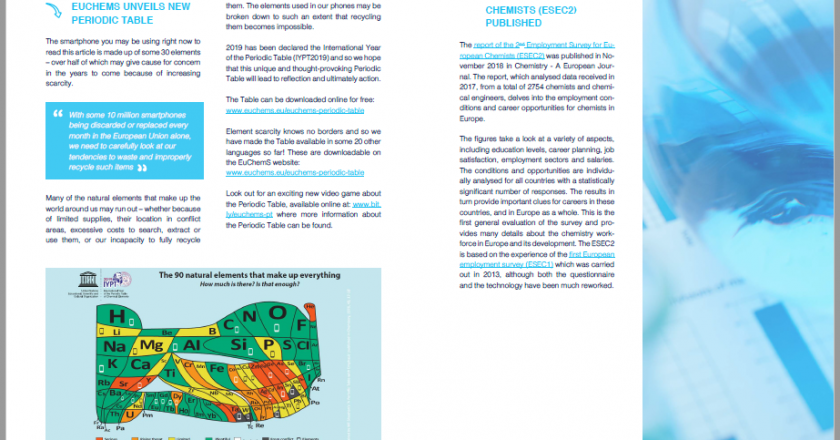
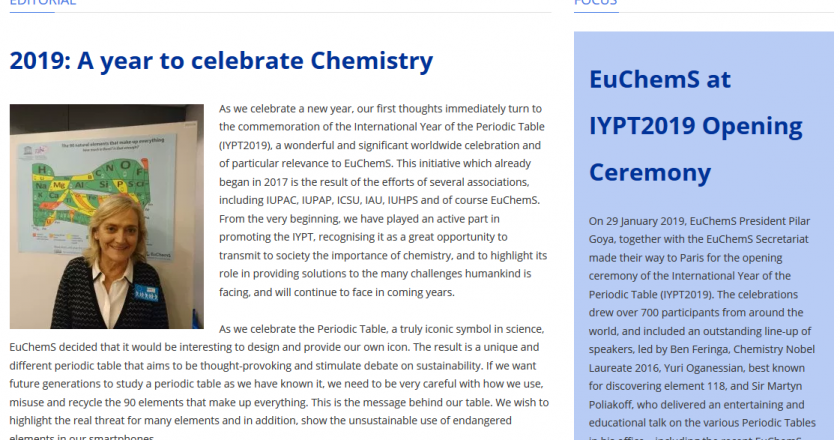
The newsletter includes a number of interesting and highly relevant contributions, news, and upcoming events, such as an editorial by Pilar Goya, EuChemS President; an analysis on the survey on the employability of European chemists; input from the European Young Chemists’ Network and Members; well as news concerning the new IYPT2019, and more besides!
Master the recipe on developing successful proposals and projects based on European Funds
Brussels, Belgium
13 – 14 March 2019
Website: http://bit.ly/2WXqR2A
6th European Chemical Biology Symposium / Meeting of EuChemS Division “Chemistry in Life Sciences” Madrid, Spain
3 – 5 April 2019
Website: http://bit.ly/2E7ojHD
Advanced nuclear systems for increased sustainability and first Generation-IV reactors are expected to be fully operational around the world in coming decades. In the meantime, all new concepts and designs currently under development, both in Europe and worldwide, will need to demonstrate compliance with evolving and ever more stringent safety requirements. In this context, a significant increase in the level of safety is expected to be demonstrated. Advanced designs should show increased resilience to severe accidents, while also offering major advantages in terms of one or more of: use of uranium resource, reduction of high-level waste production and increased proliferation resistance.
Planned Opening date: 15 May 2019
Deadline: 25 September 2019
Website: http://bit.ly/2GAJTWu
To replace fossil energy with sustainable alternatives that provide the same flexibility and convenience of use, we need to store sustainable energy on a large scale and for a long time in new kind of energy storage compounds. This can be done by direct conversion of sunlight into storable chemicals that can be stored for a virtually unlimited time. At present, these processes can be performed at the level of small prototype devices at high cost. Therefore, research and innovation are needed to bring these approaches from infancy to maturity. The production of clean forms of storable chemical energy from direct sunlight is the next step.
Planned Opening date: 7 May 2019
Deadline: 27 August 2019
Website: http://bit.ly/2WXRLHt
Call for feedback: High and low Indirect Land-Use Change (ILUC) – risks biofuels, bioliquids and biomass fuels
The European Commission has launched a call for feedback on the delegated regulation on High and low Indirect Land-Use Change (ILUC) – risks biofuels, bioliquids and biomass fuels.
Drop us a line if you would like to contribute to an EuChemS response! Deadline to send us feedback: 25 February 2019.
On 13 February, Members of the European Parliament overwhelmingly voted in favour of a non-binding resolution stating that EU Member States are failing to switch from chemical pesticides towards low-risk alternatives, despite it being required under EU law. The Parliament in turn called on the European Commission and Member States to meet their obligations.
With worries over the use of pesticides and their impact on biodiversity in Europe, the Parliament has stressed the need to make significant progress in promoting and incentivising innovation and the development of low-risk or non-chemical alternatives.
The European Commission has been called on to propose an EU-wide binding target for the reduction of pesticide use, as well as immediate bans on the use of pesticides that are at a certain distance from residential areas, schools, nurseries and hospitals.
On 7 March, EuChemS will be holding a workshop in the European Parliament in Brussels, where, together with representatives from the EU institutions, academia and industry, the state of education, employability and opportunities in Horizon Europe for the chemical sciences will be discussed and debated. The workshop will explore the meaning behind the figures of the 2nd Employability Survey of European Chemists, such as gender imbalance, acquired versus needed skills, the need to bring academia and industry closer together, and funding opportunities through Horizon Europe. The event is free to join, simply register online here, where you can also consult the programme and list of speakers. Register before 22 February!
The International Year of the Periodic Table has also provided an opportunity to discuss one of the rarely mentioned aspects of the Periodic Table: the women behind it. Shedding light on the role of women in science and in the discovery of elements is vital to better understand the lingering gender disparity, and how history has generally turned a blind eye to their plight. On 12 February, a Global Women’s Breakfast, spearheaded by IUPAC took place, with women scientists across the world coming together to celebrate women in science. EuChemS President Pilar Goya participated in the Global Breakfast in Murcia during the two-day international symposium on ‘’Setting their Table: Women and the Periodic Table of Elements’’.
Speakers at the event included Brigitte Van Tiggelen, Chair of the EuChemS Working Party on the History of Chemistry who is currently preparing a book on women and the periodic table, an EuChemS initiative for the IYPT2019. Marta Kucza from the EuChemS Secretariat presented a unique perspective on women in science through anthropological lenses.





 behind it. Shedding light on the role of women in science and in the discovery of elements is vital to better understand the lingering gender disparity, and how history has generally turned a blind eye to their plight. On 12 February, a
You must be logged in to post a comment.