According to the Environment Committee (ENVI) of the European Parliament, as long as serious concerns remain about the carcinogenicity and endocrine disruptive properties of the herbicide glyphosate, which is used in hundreds of farm, forestry, urban and garden applications, the European Commission should not renew its authorisation. According to the majority of ENVI Members of European Parliament (MEPs), there should be an independent review and disclosure of all the scientific evidence that the European Food Safety Authority (EFSA) used to assess this substance. Source: http://www.europarl.europa.eu/news/
The European Parliamentary Research Service (EPRS) has recently published an in-depth analysis of the European Research Area named “European Research Area: Evolving concept, implementation challenges”.
The analysis looks into ERA more than 40 years after the first steps to establish a common research policy, and 16 years after the formulation of the concept “European Research Area” (ERA), passing through its reshaping by the Council of the European Union in 2008 and the involvement of stakeholders since 2012, and looking into the future of ERA, where the commitment of the Member States will play a crucial role.
Source: http://www.europarl.europa.eu/
Following an invitation from the European Commission (EC) delegation, EuCheMS will be part of the EC delegation to Chile on the topic of Circular Economy, led by Mr Daniel Calleja, the European Commission’s Director-General for Environment. The mission takes place on 25-26 April 2016 back-to-back with the XIV World Mining Exhibition and Congress for Latin America.
The mission is taking place just a few months before the review of the EU-Chile Association Agreement, and will hopefully be increasing EU-Chile cooperation on sustainable development with a view to addressing the environment while opening up opportunities for growth and investment in the framework of the Circular Economy. Among other topics, the mission will focus on issues related to circular economy, resource efficiency and sustainable use of natural resources, rco-innovation, chemicals, waste management, and water management. Source: http://ec.europa.eu/easme/
The Commission has presented the draft new rules on organic and waste-based fertilisers in the European Union (EU) which will now be discussed in the European Parliament and Council of the EU. The proposed Regulation should significantly ease the access of organic and waste-based fertilisers to the EU single market, bringing them on a level playing field with traditional, non-organic fertilisers. This will create new market opportunities for innovative companies while at the same time reducing waste, energy consumption and environmental damage. The new rules would apply to all types of fertilisers to guarantee the highest levels of soil protection.
The re-use of raw materials that are now disposed of as waste is one of the key principles of the Circular Economy Package adopted by the Commission in December 2015 and discussed in September last year at EuCheMS policy workshop Protecting Endangered Elements. Source: http://europa.eu/
A call for action has been published as an outcome of the conference “Open Science – From Vision to Action”, hosted by the Netherlands´ presidency of the Council of the European Union. According to this call for action, by 2020 there should be full open access for all scientific publications as well as a fundamentally new approach towards optimal reuse of research data. In order to reach this vision, twelve action items are proposed, namely changing the assessment, evaluation and reward systems in science; creating transparency on the costs and conditions of academic communication; setting up common e-infrastructures; involving researchers and new users in open science; or stimulating new publishing models for knowledge transfer.
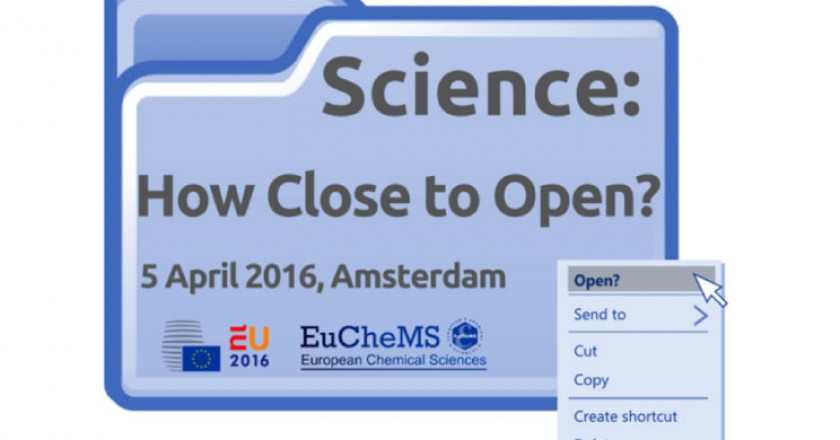
This call for action is an open, living document, and EuCheMS, based on the outcomes of the recent Amsterdam workshop “Science: How Close to Open”, will provide input on the topic of open science to the Presidency of the Council of the EU.
Also during this conference, Commissioner Carlos Moedas announced the imminent launch of the Open Science Policy Platform, which will advise the European Commission on policy actions required to implement the European Open Science Policy Agenda. Members of the platform will be announced end of May 2016.
Source: http://english.eu2016.nl/
Earlier this month in Amsterdam, EuCheMS brought together researchers, policy-makers, and publishers for a discussion about the current challenges and opportunities of Open Science. All the materials from the workshop “Science: How Close to Open?” will soon be online on EuCheMS´ website.
The European Young Chemist Award 2016 is intended to showcase and recognise the excellent research being carried out by young scientists working in the chemical sciences and will be presented at the 6th EuCheMS Chemistry Congress to be held in Seville from 11-15 September 2016. It will follow the 2006, 2008, 2010, 2012 and 2014 European Young Chemist Awards held in Budapest, Torino, Nürnberg, Prague and Istanbul during the previous editions of the European Chemistry Congresses.
Applicants must submit the following items by e-mail to euchems.award@gmail.com by 1 April 2016 in order to be considered for the award.Application information.
The Young Chemists Group of the Portuguese Chemistry Society, the 3B’s Research Group and the Chemistry Department at the University of Minho are pleased to announce the 5th Portuguese Young Chemists Meeting (5th PYCheM) and 1st European Young Chemists Meeting (1st EYCheM), which will take place in the historical and beautiful city of Guimarães – Centro Cultural Vila Flor, Portugal, from 26th to 29th April 2016.
This joint event will bring together for the first time young chemists from all over the Europe, in a high quality scientific program covering most recent research in the different areas of chemistry (organic, inorganic, analytical, etc.) and at the interface of chemistry and other scientific fields (biology, medicine, nanotechnology, etc.).
By attending to this meeting you will be able to present your results as a poster or oral presentation to a broad audience of chemists and professionals in chemical sciences. Don’t miss this opportunity to network with your peers and interact with experienced professionals from academia and industry. Prizes will be awarded to the best oral and poster communications given by a young chemist.
11:00 Welcome and Setting the Scene – David Cole-Hamilton, EuCheMS President
11:10 A Learned Society’s View on Scholarly Publishing in Chemistry – Wolfram Koch, GDCh
11:25 Open Access Publishing in Chemistry: A perspective from the Royal Society of Chemistry – Emma Wilson, Royal Society of Chemistry
11:40 Digital Single Market and Open Science – José Cotta, DG Connect, European Commission
11:55 Open Access Challenges for a Young Researcher – Cristina Todasca, University Politehnica of Bucharest
12:10 Flooding Without Drowning / Are Scientists Drowning in a Flood of Papers and Data? – Eva Wille, Wiley-VCH
12:25 Closer to Open with Springer – Steffen Pauly, Springer
12:40 Panel Discussion
13:10 Conclusions and Closing Remarks – David Cole-Hamilton, EuCheMS President
13:20 Light Buffet Lunch
This event will look into the present and future of intellectual property boundaries in chemistry research and will debate questions such as:
Which model for peer-review publishing?
Who owns research data and how to share it?
Which approach is better for creating innovative products and services?
Together with researchers, publishers, and EU and government officials we hope to build bridges between all concerned and to provide answers to questions.
For more information please contact secretariat(at)euchems.eu
During a workshop in Brussels on the 21 March 2016 aimed at stakeholders involved in Circular Economy, participants will be given the occasion to better understand the practical tools to finance the transition to Circular Economy. Read more
The Erasmus+ mid – term evaluation will assess the effectiveness of the Erasmus+ actions to achieve the programme’s objectives and evaluate the efficiency of the Programme and its European added value. Read more
The Strategy should provide input to the review of Horizon 2020 and the development of a research & innovation framework programme post – 2020. It should also provide extensively evidence – based advice that could feed in to future policy orientations and regulatory action in the Energy Union con text, and will rely on the identification and the design of credible and feasible decarbonisation pathways to 2050 and beyond. Read more
The LRI Award offers a €100,000 prize to support promising new research in the field of novel approaches to the characterisation of molecular initiating events, or other key events, in pathways of human and environmental toxicity.
The European Young Chemists’ Network has launched the first edition of the European Photography Contest – PHOTOCHIMICA 2016.
Under the theme “Chemistry is Everywhere” chemists and not chemists under 35 who are passionate about photography and chemistry are invited to participate. EYCN wants to promote chemistry through the power of visual arts, by showing its presence in all of our everyday activities.
On the 23 February, the European Parliament Environment, Public Health and Food Safety Committee (ENVI Committee) will hold a hearing on real drive emission tests. This hearing will host expert speakers, aiming to inform ENVI on the development of real driving emissions tests.
A key feature of ENVI’s position is that test procedures for certain pollutant emissions should reflect real driving conditions instead laboratory emissions testing.
The evaluation was based on a report by an independent group of high level experts, as well as the Commission’s response to its recommendations published in two legal documents.
The main findings are that FP7 was effective in boosting excellent science and strengthening Europe’s industrial competitiveness, contributing to growth and jobs in Europe. The evaluation also identified ways to improve how the EU funds research and innovation such as avoiding duplication or promoting large-scale simplification. According to the European Commission, many of these issues are already being taken up by Horizon 2020, the successor programme to FP7.
In its 25,000 funded projects FP7 had a vast group of participants with more than 134,000 participations from 170 different countries. The participations came in 86% of the cases from EU countries, 8% from Associated Countries and 6% rest of world.
On the occasion of the Open Science Conference organised by the Dutch Presidency of the Council of the EU, EuCheMS is organising the workshop Science: How Close to Open?, taking place in Amsterdam on 5 April.
This event will look into the present and future of intellectual property boundaries in chemistry research and will debate questions such as:
Which model for peer-review publishing?
Who owns research data and how to share it?
Which approach is better for creating innovative products and services?
Together with researchers, publishers, and EU and government officials we hope to build bridges between these different actors and to provide some answers to these questions.
Registration for this event will soon be available!
This consultation aims to collect views on the EU’s Action Plan against risks arising from antimicrobial resistance (AMR) and is one part of a larger evaluation process which covers the period 2011-2015 in all 28 EU Member States and relevant third countries. The evaluation runs from August 2015 to March 2016. It aims to assess:
Whether the key strategic actions contained in the Action Plan were the most appropriate actions to be taken to combat AMR;
Which elements worked well or not (and why);
Whether the objectives are still relevant to the needs of tackling AMR; and
Whether the approach was appropriately holistic.
The evaluation also involves surveys, interviews and workshops to collect views from multiple perspectives, including policy makers at the EU and national levels, researchers, public health experts, and representatives of professional associations and other interested parties who are in a position to comment on the Action Plan and its implementation.