As a science-driven organisation, the European Medicines Agency (EMA) has recently developed a framework to formalise, structure and further develop interactions with the academic community in the context of the European medicines regulatory network. The framework’s overall objectives are: 1) to raise awareness of the mandate and work of the European medicines regulatory network to increase academia’s trust in and engagement with the regulatory system; 2) to foster the translation of academic research into novel methodologies and medicines; 3) to ensure that the best scientific expertise and academic research are available on time to support effective evidence generation, regulatory advice and guidance, as well as decision-making in regulatory processes; 4) to work with academia to develop regulatory science that embraces scientific progress in medicines development without compromising patient safety.
The European Chemicals Agency has published information on around 15 000 chemical registered substances on its website. This information covers the intrinsic properties of each substance and their impact on human health and the environment. The data comes directly from companies who make or import the substances and have registered them with ECHA. Researchers, regulatory authorities and businesses can use it, not least to improve the safe use of chemicals, enable innovation and help avoid the unnecessary testing of chemicals on animals.
The system covers dangerous non-food products intended for consumers (e.g. a toy, a cosmetic product, clothing, childcare products) and for professionals, which pose a serious risk to their health and safety, such as risks of injuries, chemical risks, etc. The system also includes alerts concerning products that pose other indirect hazards to consumers and the environment caused by the presence of heavy metals and persistent organic pollutants that can contaminate soil and water.
On the occasion of the World Water Day on the 22 March, European Commissioner Katainen, Commissioner Hogan, and Commissioner Vella released a joint statement on the topic of water. In this statement, the Commissioners affirm that the Commission will propose in 2017 a revision for the Drinking Water Directive as well as a proposal to encourage further uptake of reused urban waste water for agriculture and to recharge groundwater aquifers, “showing that circular economy can be concretely deployed in many economic sectors with win-win solutions”. The issue of water reuse was recently discussed at the EuCheMS workshop From Waste to Health.
After three years of work, the review of the EU environment standards for waste treatment is reaching an end. During the final stakeholder’s meeting, the stakeholders, together with the European Commission, completed the technical work to define the Best Available Techniques (BAT) conclusions for the waste treatment sector as part of the review of the Waste Treatment Best Available Techniques Reference Document (BREF), dated 2006, under the Industrial Emissions Directive. The BAT conclusions and BAT-associated emission levels, once published in the Official Journal of the EU, will be the reference for the authorities across the EU to set operational permit conditions for the around 4 000 waste treatment facilities affected. The European waste treatment sector is extremely varied and carries out treatments such as shredding of end-of-life vehicles, treatment of lamps containing mercury, composting of biowaste, re-refining of waste oil or regeneration of spent solvents.
On 16 March, Members of the European Parliament voted in favour of making EU companies take responsibility for the origin of the minerals they import. Companies will have to check their supply chain in order to respect human rights and prevent them from contributing to conflicts from 1 January 2021 onwards. EU countries will be responsible for ensuring that companies comply. The regulation will also have an impact beyond the EU, as smelters that want to supply to the European market will have to be certified. EuCheMS has discussed the issue of conflict minerals as well as the issue of substituting the raw materials coming from conflict zones.
The European Parliament (EP) services have recently published a report for the EP Environmental, Public Health and Food Safety (ENVI) Committee on secondary raw materials for a circular economy. This report summarises four presentations by experts and discussions which took place at the workshop “Supporting the market for Secondary Raw Materials in a Circular Economy” held on 31 January 2017 in the EP in Brussels. The aim was to provide background information to the ENVI and Industry, Research and Energy (ITRE) Committees’ Members and contribute to their understanding of the role and opportunities for secondary raw materials as part of the implementation of the Circular Economy Action Plan, including the proposed waste legislation which are currently under discussion.
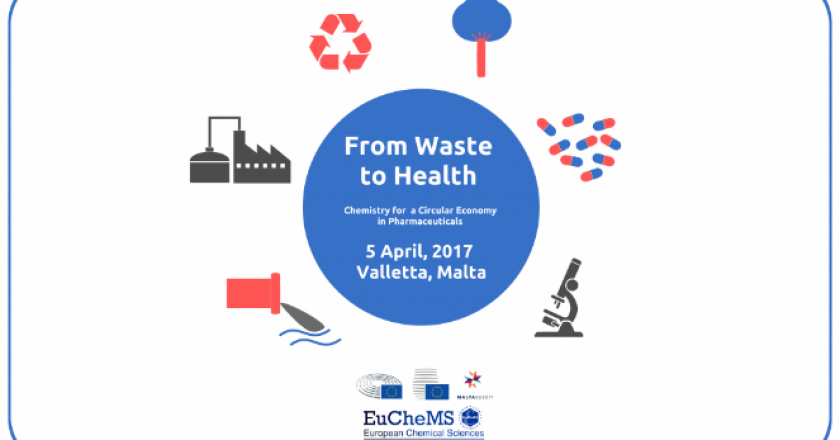
Earlier this month in Malta, EuCheMS brought together researchers and policy-makers to discuss the unique environmental and economic opportunities of circular economy in the field of pharmaceuticals. All materials and conclusions from the workshop From Waste to Health will soon be published at EuCheMS´ website but in the meantime, you can already watch the video of MEP Miriam Dalli´s intervention at the event.
Member of the European Parliament (MEP) Pavel Poc, EuCheMS and ECTN would like to invite you to a debate on glyphosate taking place on the 10 May at the European Parliament in Brussels. Join this debate with ECHA representatives and leading experts on glyphosate and discuss glyphosate’s possible negative effect on human health, specifically in relevance to the biological molecular processes, metabolism, genotoxicity, endocrine disruptors, antimicrobial resistance, and other serious health related concerns. Registration is now open here. In preparation for this workshop you can read news on glyphosate not being classified as a carcinogen by the European Chemicals Agency (ECHA) as well as a paper on glyphosate written by MEP Pavel Poc and Pavel Drašar, Member of the EuCheMS Executive Board and President of ECTN.
The European Association for Chemical and Molecular Sciences, EuCheMS, condemns in the strongest possible terms the continuing use of chemical weapons in the Syrian conflict. It calls on the perpetrators to be tried for War Crimes at the earliest possible moment. The use of chemical weapons is a crime against humanity of the severest kind and no one who orders attacks using chemical weapons should be allowed to remain free. We further call on all parties in the Syrian conflict immediately to inform the Organisation for the Prohibition of Chemical Weapons (OPCW) of all know stockpiles of chemical weapons held by them or their opponents and to allow them to be removed and destroyed at the earliest possible opportunity.